
Write-in elections, low voter turnout an ongoing trend in Ashland municipal elections
For the fourth time in five years, there are open positions for which no candidates have filed to run in the city of Ashland.
Two seats on the Board of Aldermen will be filled by write-in votes in the upcoming April election, City Clerk Darla Sapp said.
Two years ago, with a total of four votes against 26 other written-in names, Brenda Ravenscraft won the Ward 1 seat no one had filed for, including her.
“I got a text later that night after the polls closed, and the votes were counted,” Ravenscraft said. “’Congratulations…’ I go, ‘What? No, I did not run.’”
But Ravenscraft said she’s not a quitter, so she decided she would accept and stick it out for the two years.
Two years later, her term is up, and she has no plans for an encore.
She said she doesn’t like all the negativity attached to the position. She said she’s been called many names, from “bigot” to “white supremacist.”
“And obviously, these people do not know this ‘crazy lady,’” Ravenscraft said, “because I’m none of that stuff.”
She said she isn’t on Facebook anymore after she deactivated her account.
“I’ve got strong shoulders,” she said. “But I just don’t need that.”
Gene Rhorer, former mayor of Ashland, also said that the harsh comments on social media often became personal.
“People on Facebook that don’t know about you or your family say terrible things about you,” he said. “People will just outright threaten you and bully you.”
“That deters a lot of people” from wanting to run for election, he said.
“I hate seeing the write-ins because that’s not really the way we want to see it done,” Rhorer said. “We want people to run against one another so we can have somewhat of a selection.”
In addition to positions where no one filed, Ashland has had at least one position on the general municipal ballot with just one candidate running every year for five years. Rhorer said that could be because it takes a certain kind of individual to seek out the unpaid position and the harsh feedback that comes with it.
“You can’t please everybody and you’re going to get some backlash,” Rhorer said. “I don’t know that there’s a lot you can do to appease that, to have people run and to get people who have to deal with that. And there are parties out there across the nation that have done that to us, so that makes it difficult for good people to participate.
“How do you remedy that in a world where politics is deemed evil now?”
Voter turnout
None of Ravenscraft’s neighbors has jumped at the chance to be her successor. Only 34 of them voted at all in her election year, part of the only 14% of registered voters in Ashland who cast their vote for mayor or alderman in 2024.
Ward 3 Alderman Bryce Beal, the former assistant attorney general and now the general counsel to the Missouri Senate, noted Ashland has an “issue … with getting people to turn out and really dive in and care about their local elections.”
“At the end of the day, the local government are the ones responsible for keeping your street paved, and your vital services, like water and trash,” Beal said.
“Having a voice and input in that is so important to the things that you experience every day in the community,” he added.
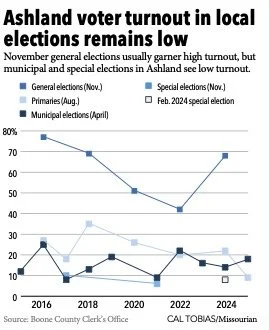
In the past 10 years, fewer than a quarter of Ashland residents have made it to the polls in April, and fewer than 10% have voted in special elections.
Beal noted the 7.86% voter turnout in a special election in February 2024. “And you’re talking about a major project,” he said.
That special election was held for residents to vote on a bond referendum to approve the issuance of wastewater revenue debt for the expansion project and other necessary system improvements.
According to the Boone County Clerk’s Office, 117 people voted “yes” on the measure and 138 voted “no,” totaling less than 8% of registered voters.
But the existing sewer system was nearly at capacity, determined by regulations set by the Missouri Department of Natural Resources.
In March 2025, now-former City Administrator Kyle Michel said in a news release that the referendum was intended to qualify the project for the State Revolving Fund through the Department of Natural Resources, which offers discounted interest rates.
“Despite efforts to educate the public on the need for the expansion and the cost savings available through SRF funding, the referendum failed, largely due to voter assumptions that the City would not proceed with the expansion without voter approval,” Michel said in the release.
“I think a lot of people may have not understood what the project was, and what all was going on,” Beal said. “(The city) would’ve received a better interest rate, and it would’ve been more cost effective to go through the bonding process.”
The Journal reported in September 2025 that the average water bill for Ashland residents will increase from $52.65 a month to $64.76 in fiscal year 2026, $79.65 in 2027, and $97.97 in 2028.
Rhorer said that most of the “mouth-work,” as he called it, on Facebook comes from residents who don’t take the time to inform themselves so they “know what the heck they’re talking about and understand the process.”
“They don’t have a clue and they’re not interested in finding out,” he said. “They just want to comment on it.”
“You cannot complain about things unless you have voted,” Ravenscraft said. “You have no right to say anything unless you go to the voting polls and, and put your two-cents in. That’s why we have elections. If we care about our country and about our city, and about our state, and about our town, and we’ve got a right to vote, I think we need to show that we do care.”
Beal said it is “absolutely vital to society” that elected officials hear from constituents and that the people have a voice in their government.
“The most efficient way to do that is go to the polls,” he said.
