
Responding to community questions about the consideration of a four-day school week at Southern Boone
The Southern Boone R-1 School District is considering switching to a four-day school week calendar to improve teacher retention and recruitment.
The Journal received the questions submitted for the Oct. 9 community presentation and the feedback survey following the presentation. We’ve reviewed the responses and identified the repeated, pressing or unanswered questions to provide the Southern Boone community with further information and clarity about a four-day school week.
Teachers, staff, and salary
Does this mean the four-day week is now taking the place of a raise? Will our raises now be frozen?
No. Superintendent Tim Roth confirmed during the Oct. 9 community presentation that the district’s finance committee will continue to discuss raises and salary steps for the upcoming school year.
Would the 4 day week change any employee benefits, specifically the number of PTO days?
No. Roth confirmed on Oct. 9 and again at the Oct. 13 school board meeting that there are no significant changes expected to employee benefits, including paid time off, if the district were to make the change.
I’m hearing from school employees that their hours will be reduced if the district goes to a four-day schedule. The perception seems to be they won’t be working the ‘off’ day, therefore won’t be paid what they are now. Please provide details, is this true, or will compensation be adjusted so employees make the same amount?
The district would adjust pay scales to “to protect employee earnings,” according to the district’s four-day information page.
Are teachers leaving mostly for an increase in pay or moving for other reasons?
Roth and Middle School Principal Brandy Clark said exit surveys confirmed the majority of departing staff leave because of pay at the Nov. 3 four-day school week committee meeting
How does the Southern Boone teacher pay scale compare to the districts it is losing teachers to?
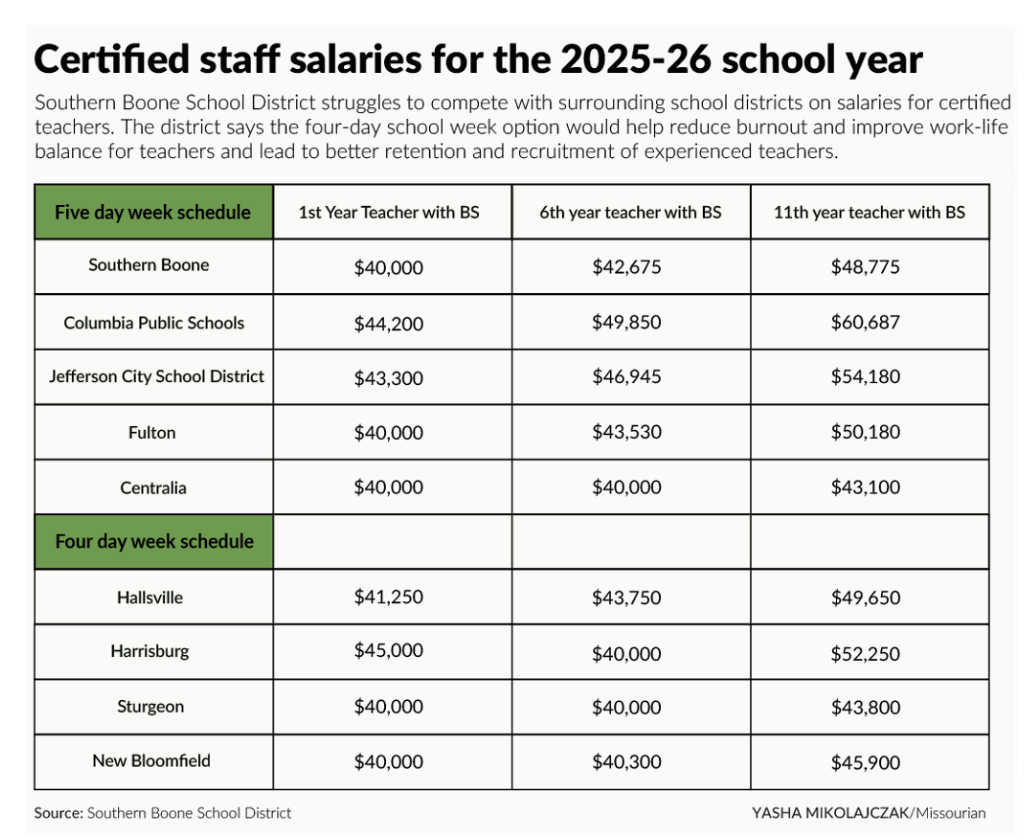
Why can’t the district just pay teachers better?
A: The district said that revenue limits make salary increases alone difficult. Currently, the district’s operating tax levy is at its ceiling, sitting at $4.1846 per $100 of assessed value, meaning any increase to the levy would require the district to put the increase on the ballot of the next election. Salary and benefits accounted for nearly 74% of the district’s total operational expenditures in the 2025-2026 annual budget, leaving the district limited corners to cut.
Data and “Proof”
Has data been collected from other districts or is it anecdotal?
The data Southern Boone has shared with the community from other school districts contains a mixture of hard data and anecdotal claims. However, the external data, both qualitative and quantitative, is consistent with research about the impacts of a four-day school week. A 2021 report from Rand, a nonprofit research organization, found that the majority of qualitative findings were consistent with quantitative findings regarding the four-day school week.
Does the district have any proof or data that a 4 day school week improves teacher retention or recruitment?
Previous reporting from early October found studies from the Prime Center and Economics of Education Review that suggest “beneficial teacher recruitment and retention effects are most prevalent in rural schools” and “in states where the four-day school week is motivated by teacher recruitment and retention efforts.” A working paper published in June, however, found “no indication that the total recruitment of new teachers is improved by the 4DSW, overall or in high-need fields.” Overall, research continues to yield mixed results, indicating that district characteristics, such as geographic location, population density, and driving motivators of change, often determine the impact of the change.
Have you surveyed any schools that tried the 4-day week and returned to the 5-day week and what were their reasons for doing so?
Four-day school week committee member Hannah Riggs reached out to Mexico School District and Fulton School District officials to learn more about their decision against moving to a four-day school week.
Scott Lowe, president of the Fulton School Board, said that the district has determined it “cannot, in good conscience, eliminate another instructional day without risking a decline in student achievement.” Lowe also said the district plans to remain on a five-day week schedule to “continue supporting students’ food security and physical safety.”
Mexico School Board President Jessica Ekern said the board unexpectedly decided to remain on a five-day week when one vote went differently than anticipated. Ekern said some board members had “determined that available data was inconclusive in showing that such a change would effectively address teacher recruitment and retention challenges” and were concerned about academic impact and the true “off” nature of Mondays for teachers.
Student Impact
Has [the district] looked at the educational impact on kids in regard to this change?
A report from the Missouri Department of Elementary and Secondary Education found that a four-day school week results in either a decrease in or no effect on student academic achievement. However, the study notes that “a decrease in total annual instructional time because of a switch to a four-day week might be a key mechanism for lower student achievement” and “negative results were more pronounced for the non-rural districts.”
Has the district reviewed any longitudinal research on students who began their education in a four-day school week model in Kindergarten and remained in it through graduation? Specifically, how do their academic, social-emotional, and post-secondary outcomes compare to peers who followed a traditional five-day model?
While longitudinal data specifically following a class of students through their entire K-12 education on a four-day school week has yet to be compiled or analyzed, a 2021 study found the impacts on elementary and primary students academically and culturally to be minimal.
How many hours of attendance/instructional time is there currently vs. the proposed four-day school week?
Currently, the district has 1,086.95 hours of student instruction in 167 days. The draft 2026-2027 four-day week calendar would comprise 1,074.13 hours of student instruction in 148 days, around 1% fewer hours than students currently receive.
Paul N. Thompson, a leading researcher on the four-day school week, concluded in 2021 that new research suggested the four-day school week is “not detrimental for achievement per se,” but that four-day school weeks implemented in districts with less time in school overall are more likely to have “meaningful” adverse impacts on student academic progress.
Why don’t we vote on this like other districts have?
Senate Bill 727 requires any school district located within a city with more than 30,000 residents to seek voter approval for a shortened school week.” Voters in the Hallsville School District recently approved the continuation of a four-day school week calendar in a November vote. Approximately 235 acres of the Hallsville district are situated in far northern Columbia, a city with nearly 130,000 residents, which requires the district to seek voter approval under the new law.
